Transcripts
A transcript is one conversation with a hosted agent: what the visitor typed, what the agent replied, and which tools it used. Transcripts apply to the whole site. You'll find them on the Transcripts tab of either agent's page, and they list conversations from every hosted agent on the site.
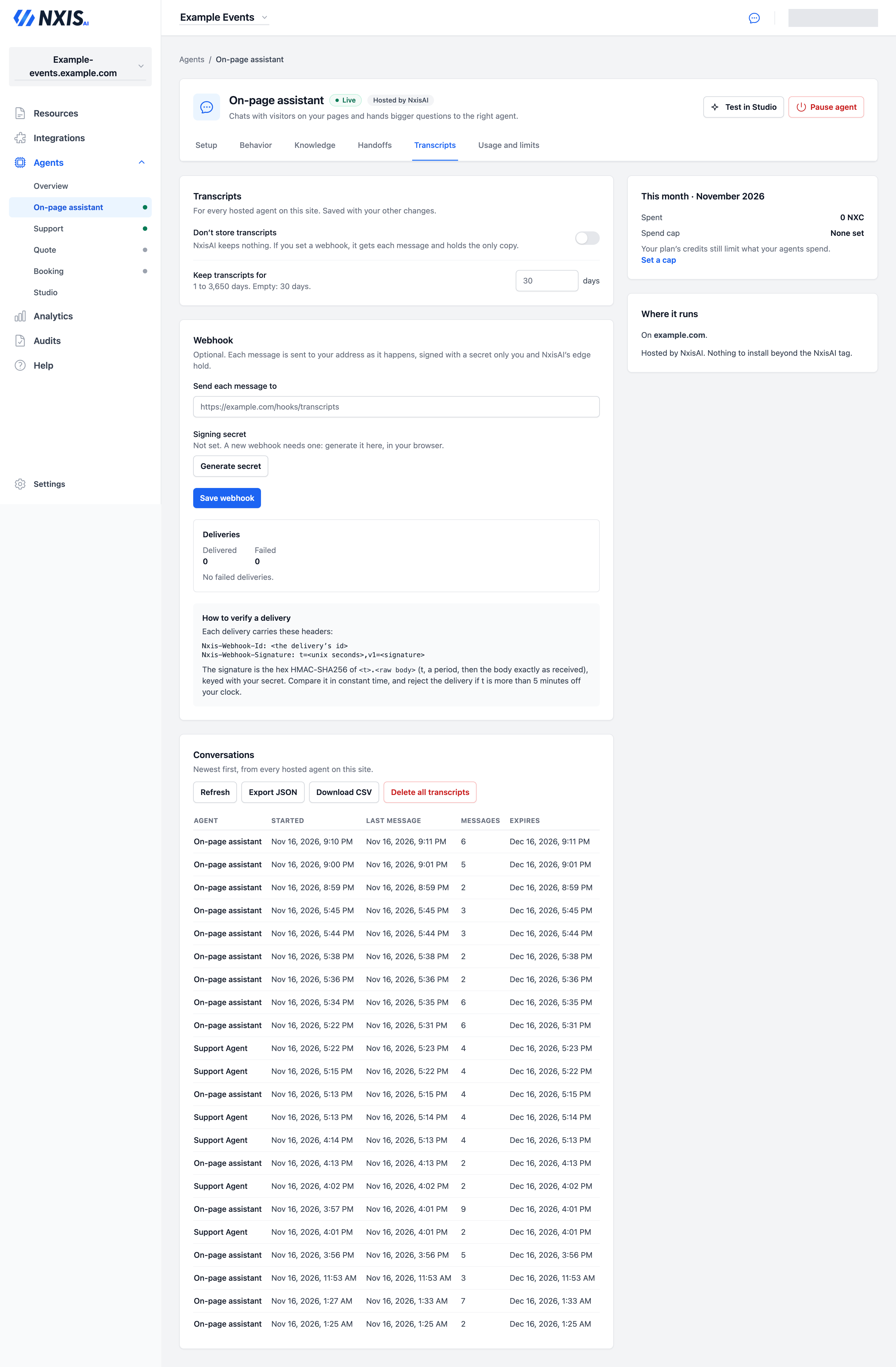 The Transcripts tab: how long conversations are kept, the webhook, and the conversations themselves.
Storage choices
| Choice | What NxisAI keeps |
|---|---|
| Keep transcripts (the default) | Each message, for 30 days, or for the number of days you set, from 1 to 3,650 |
| Don't store transcripts | Nothing. The webhook is the only copy, so set one up first |
- Expired messages are deleted, not hidden. Each conversation shows when it expires.
- A shorter period applies at once, to what's already stored as well as to new conversations.
- Don't store needs a webhook. You can't turn storage off without a webhook, or remove the webhook while storage is off, so conversations always reach you somewhere.
From the CLI:
nxis agents transcripts settings --retention-days 90
nxis agents transcripts settings --dont-store     # or --store to turn storage back on
What's stored
Text is redacted before it's stored or sent, so neither the transcript nor the webhook ever holds the original. Redacted text shows a marker in its place:
| Marker | Replaces |
|---|---|
[email] | Email addresses |
[phone] | Phone numbers (seven or more digits) |
[card] | Card numbers (13 to 19 digits) |
[number] | Any other run of five or more digits |
[postcode] | UK and Canadian postcodes |
[ip] | IPv4 addresses |
[secret] | Keys, tokens, passwords and other secret-shaped strings |
Dates, times, prices and short numbers are kept. Names and street addresses aren't caught, so a transcript can still hold them.
Each message is stored up to 8,000 characters. The conversation list shows a 120-character preview of the visitor's first message.
Reviewing and deleting
The Conversations list shows the newest first, with the agent, when the conversation started, its last message, the number of messages, and when it expires. Open one to read every message in order.
- Delete conversation removes one conversation.
- Delete all transcripts removes every conversation on the site.
Deletion is immediate and can't be undone. Deleting the site deletes all of its transcripts.
From the CLI:
nxis agents transcripts list --limit 20
nxis agents transcripts show <id>
nxis agents transcripts delete <id>      # or --all; asks first
Export
| Format | In the dashboard | From the CLI |
|---|---|---|
| JSON | Export JSON | nxis agents transcripts export --out transcripts.json |
| CSV | Download CSV | nxis agents transcripts export --format csv --out transcripts.csv |
The CSV has one row per message, with the columns transcript_id, agent, conversation_start, conversation_last, message_count, message_id, message_time, role, text, refusal, tool_call and turn. Times are in UTC. The file is UTF-8, and a value that a spreadsheet would read as a formula is prefixed with '.
Webhook
A webhook sends each turn to an HTTPS address you choose, as it happens. Use it to keep conversations in your own system, or as the only copy when storage is off.
In the dashboard: on the Transcripts tab, enter the address under Send each message to, select Generate secret, copy the secret, and select Save webhook. The secret is shown once and can't be read back. Generating a new one replaces it, and the old one stops working.
From the CLI:
nxis agents transcripts webhook set https://example.com/hooks/nxis
nxis agents transcripts webhook status    # delivered and failed counts
nxis agents transcripts webhook remove
webhook set prints the new signing secret once. --keep-secret changes the address and keeps the current secret.
What's sent
One POST per turn, with the redacted text. A message's role is visitor, agent or tool; it can also carry refusal (the guardrail rule that refused the turn) and call (the tool the agent called):
{
  "type": "transcript.turn",
  "id": "6f1c2a9e-3b7d-4c51-9a0e-2d8f4b6c1e73",
  "site": "0123456789abcdef01234567",
  "agent": "support",
  "conversation": "s_4e0b7f2c9d1a4b8e",
  "at": "2026-11-17T15:04:05.000Z",
  "messages": [
    { "id": "0d3e5a71-8c2f-4b9a-b6e4-7f1a2c3d4e5f", "role": "visitor", "text": "Can I change my delivery address? It's [postcode]." },
    { "id": "9b8a7c6d-5e4f-4a3b-8c2d-1e0f9a8b7c6d", "role": "agent", "text": "Yes. Our delivery FAQ says you can change it until the order ships…" }
  ]
}
Each delivery carries three headers:
| Header | Value |
|---|---|
Nxis-Webhook-Id | The same on every retry of a delivery, so you can drop duplicates |
Nxis-Webhook-Timestamp | When it was sent, in Unix seconds |
Nxis-Webhook-Signature | t=<unix seconds>,v1=<hex>: an HMAC-SHA256, with your secret, of <t>.<raw body> |
Verifying a delivery
Check the signature against the raw body before you parse it, and reject a delivery whose t is more than five minutes off:
import crypto from 'node:crypto';

export function verify(rawBody, header, secret) {
  const parts = Object.fromEntries(header.split(',').map((p) => p.split('=')));
  const t = Number(parts.t);
  if (!t || Math.abs(Date.now() / 1000 - t) > 300) return false;
  const expected = crypto.createHmac('sha256', secret).update(`${t}.${rawBody}`).digest('hex');
  const given = Buffer.from(parts.v1 ?? '', 'hex');
  return given.length === 32 && crypto.timingSafeEqual(given, Buffer.from(expected, 'hex'));
}
Retries
- A
2xxresponse counts as delivered. - A
5xx,408or429, a timeout (10 seconds) or a failed connection is retried, with growing gaps, for about two hours (up to 8 attempts). - Any other
4xx, or a redirect, isn't retried.
The latest 200 failed deliveries are kept per site, without message text, and the Deliveries panel shows how deliveries are going.
Related
- Pause, limits and retention: everything NxisAI keeps, and for how long
- Data processing agreement